Calming an Active Border Collie: What Actually Helps (and What Doesn't)

Updated: Jun 8
If you're reading this at 9pm with a Border Collie still pacing the lounge room, you're not alone. The dog had a walk this morning. A game of fetch this afternoon. And the brain still hasn't switched off. That's not a behaviour problem. It's a working-bred dog that hasn't filed today as "finished."
Calming a Border Collie isn't really about calming them. It's about giving the brain enough of the right kind of work that the dog comes down on their own. Below is what tends to help, in the order most owners find useful — and a few things that get sold as calming aids but don't move the needle much.
Why "just walk them more" usually doesn't work
The most common advice for an active Border Collie is more exercise. It's not wrong, but it's incomplete. Two hours of running can leave a Border Collie physically tired and still mentally wired. A working dog that's been bred for centuries to read sheep, anticipate movement, and make decisions needs that kind of mental load, not just leg work.
If you haven't already, our piece on how to tell if your working dog is bored, not naughty walks through the signs of an under-stimulated brain. The fixes here build on that.

1. Swap repetitive fetch for herding-style work
Fetch is fast cardio. It also winds a Border Collie up — the dog locks into chase mode, the arousal climbs, and they finish more keyed-up than when they started. Herding-style work uses the same drive but channels it differently. The dog circles, pushes, watches, and reads movement instead of sprinting back and forth.
What this looks like at home
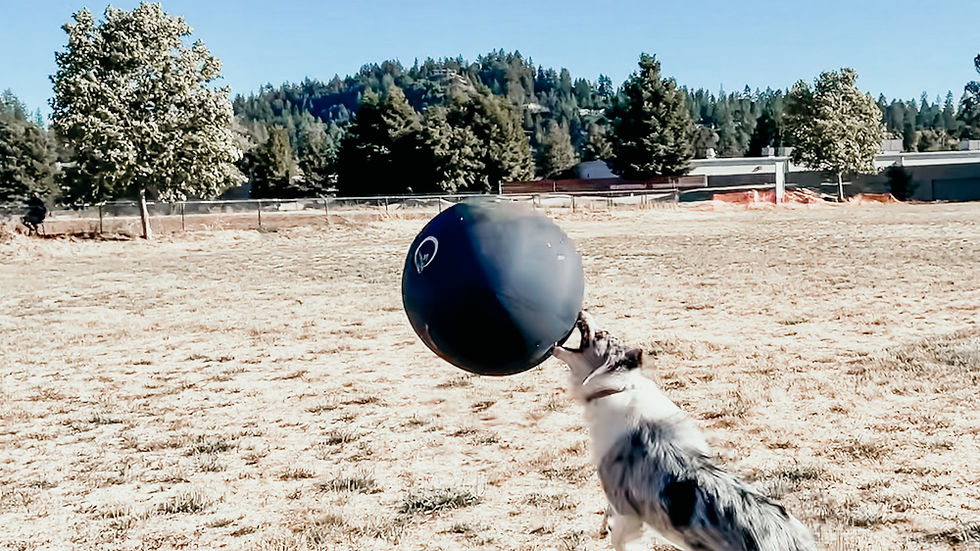
A herding ball is the easiest way to set this up in a backyard. The dog can't pick it up — it's too large — so they're forced to push it with the chest and nose, the way they'd move a sheep. For a Border Collie, the 55cm CollieBall package is the size most owners settle on. If you're between sizes, the size guide runs through it.
Session length matters
Twenty minutes of dog-led pushing tends to settle a Border Collie better than an hour of repetitive fetch. Let the dog set the pace. If they lie down to watch the ball, that's still work — they're using their brain, not just their legs.
2. Add sniff walks instead of more power walks
A slow, sniffy lead walk where the dog gets to read the environment is more settling than a fast walk. Sniffing engages problem-solving circuits and signals "off-duty" to a brain that's used to scanning. Border Collies that go on regular decompression walks usually nap heavily afterwards.
How to do it
Quiet bush track or low-traffic suburb, long lead, no agenda, the dog leads. Half an hour is enough. Don't fill the time with commands or training — the point is to let the dog choose what to investigate.
3. Front-load the day with mental work
A puzzle feeder at breakfast, a five-minute shaping session before the morning walk, a scatter feed in the backyard before lunch — these are small, low-equipment interventions that take the edge off the day. A Border Collie that has done genuine thinking is harder to wind up later.
Easy starting points
Snuffle mat for the morning meal
Frozen Kong with their own kibble and a splash of bone broth
Teach a new trick for 5 minutes — shaping, not drilling
Scatter half their breakfast across the lawn
4. Teach a real off-switch
Most Border Collies don't know how to be off-duty. They watch the household, follow movement, and scan for jobs. Teaching a settle — a mat, a bed, a specific cue that means "this is rest time" — is one of the most useful long-term skills you can build.
How most owners build it
Pick a mat. When the dog lies on it, reward with a calm chew (frozen Kong, dental chew, anything that takes time). Build duration gradually. Over a few weeks, the mat becomes a cue that means "settle here" — useful in the evenings, when guests arrive, or when you need the dog to step out of the action.
What not to do
Don't use the crate as a punishment, and don't try to force a calm state by holding the dog still. Both backfire. The settle has to be something the dog opts into because it's been rewarded over and over.
5. Watch the household triggers
Border Collies absorb the energy around them. A busy kitchen, kids running through the lounge, the doorbell going every afternoon — these things keep the dog "on." You don't need a silent house, but noticing the patterns helps. Many owners find that giving the dog a quiet space behind a baby gate during the household's busiest hour does more than any training drill.
Common triggers worth managing
Front-door noise and visitors
Kids playing chase or wrestling indoors
Other dogs walking past the fence
The TV at high volume during the evening
Cooking smells and movement around food prep
6. When to call a vet or behaviourist
Most Border Collies who seem un-calmable are under-stimulated, not unwell. But there are a few cases where professional input is the right move:
Sudden change in arousal levels that wasn't there a month ago
Obsessive light or shadow chasing that interrupts eating, drinking, or sleep
Pacing that continues even after a long day of work and enrichment
Aggression appearing in a previously settled dog
Self-directed behaviours like flank-sucking or repetitive licking
Behavioural changes can have medical causes — pain, thyroid issues, neurological conditions — and a vet visit is the right first step. After that, an experienced force-free trainer or veterinary behaviourist can help with the cases that don't resolve through enrichment alone.
Things that get sold as calming aids
A quick word on the products that get marketed for hyper Border Collies. Calming chews, lavender sprays, weighted vests, and pheromone diffusers help some dogs at the margins, but none of them substitute for the work above. If your dog needs the brain used and they're getting calming chews instead, the underlying issue stays.
If you want to try one of these, treat it as an add-on while you build the enrichment and settle work, not as a standalone fix.

Putting it together
Calming an active Border Collie is less about one trick and more about a weekly rhythm. Mental work in the morning, channelled herding or shaping sessions a few times a week, sniff walks on the weekend, a settle taught and reinforced, and a household that doesn't accidentally keep the dog wound up. The dogs that come down well are the ones whose owners build all four.
For more on the underlying behaviour, see our Border Collie owner's field guide and our piece on how to calm a hyper dog without punishment.
CollieBall ships every order from our Tweed Heads NSW base. The size guide matches your dog by breed, then cross-checks shoulder height and weight — all in metric (cm and kg).


Comments